
AS Oracle Recovery Studio — Oracle Database Recovery Software
Recover tables and rows from Oracle datafiles and Data Pump export files that will not open — damaged, dropped, truncated or hit by ransomware.
Overview
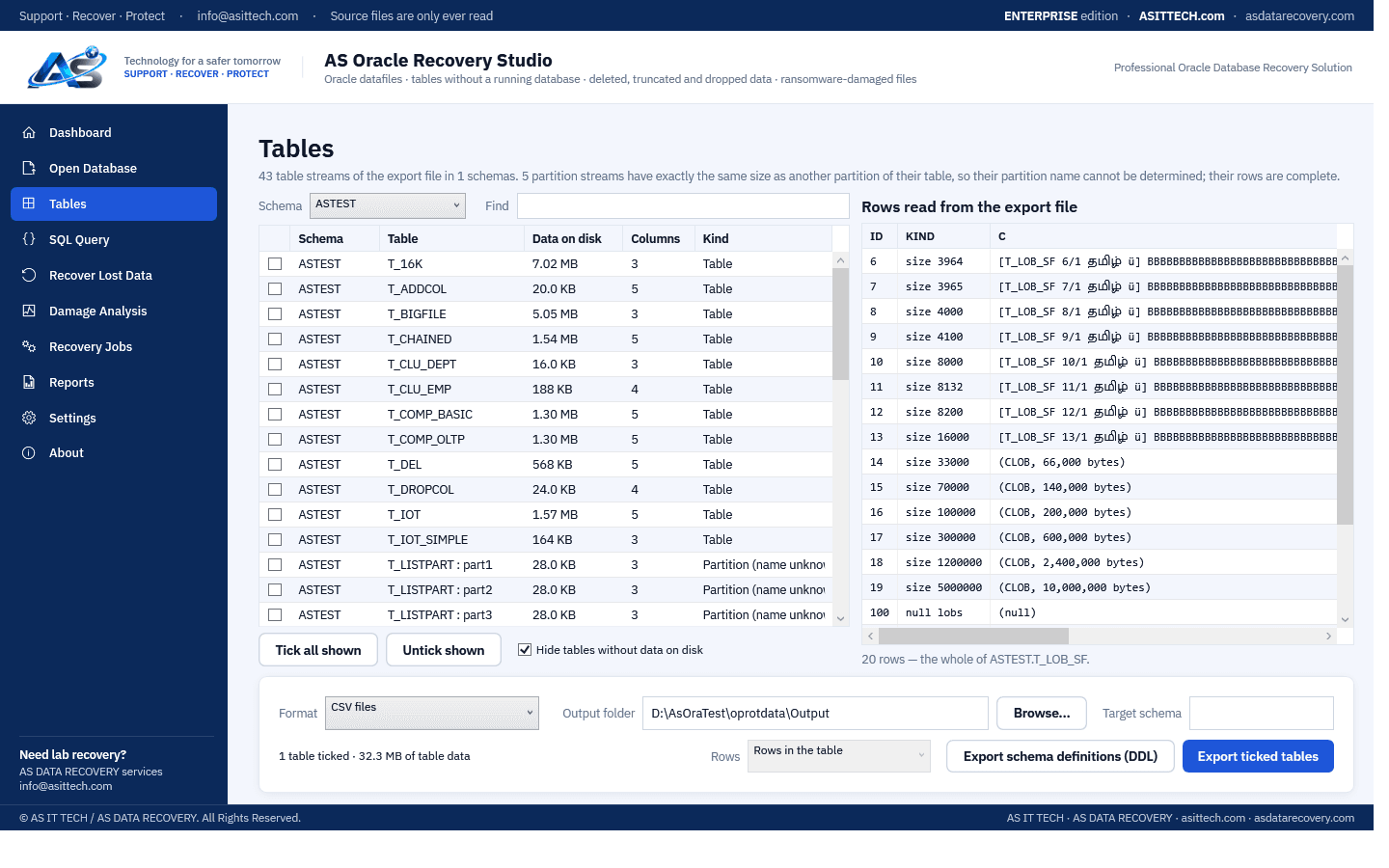
AS Oracle Recovery Studio reads Oracle datafiles directly — no Oracle installation is needed and the database does not have to open. It reads the data dictionary from the SYSTEM datafile, lists the tables with their owners, names and columns, and recovers their rows; when the dictionary itself is destroyed, tables are worked out from the rows. It also opens Data Pump export files (expdp .dmp), including files whose beginning was encrypted by ransomware: every table inside such a file carries its own description, so the tables after the destroyed part are read with their real names and columns. Every block is checked on its own and the damage is mapped, and rows on destroyed blocks are reported as missing, never invented. Recovered data is exported as CSV, SQL scripts or SQL*Loader files, or loaded straight into a running Oracle database. The original files are only ever read.
Physically failed media and complex incidents need a service engagement.
Database recovery servicesFeatures
- Oracle datafiles read without a running database: heap, clustered, partitioned, index-organized and compressed tables, chained and migrated rows
- Data Pump export files (.dmp): every table with its name and columns, also when the start of the file is encrypted or destroyed
- Ransomware-damaged files: block-by-block damage analysis; every row on the surviving blocks recovered
- Deleted rows, truncated tables and partitions, and dropped tables recovered from blocks Oracle has not reused
- Databases without a usable data dictionary: tables rebuilt from the rows with generated names
- LOB viewer for BLOB / CLOB values: type detection, compressed content shown as text, ZIP listing, hex view, save to file
- SQL Query page: run SELECT statements with WHERE, GROUP BY and ORDER BY over the recovered tables
- Export to CSV, SQL script, SQL*Loader or direct load into a running Oracle database, with reports (HTML and PDF)
Supported environments
- Windows 10 / 11, Windows Server (64-bit)
- Tested on a real ransomware case: a 354 GB Data Pump export with its first 128 MB destroyed, all 8,132 tables found
- Validated on Oracle 11g R2 and 21c datafiles (Windows / Linux x86, 8K and 16K blocks) and on 21c Data Pump exports
- Oracle 10g, 12c, 18c and 19c use the same block format but are not yet validated on real files; ASM disk groups are not supported
System requirements
- 64-bit Windows
- No Oracle installation needed to read the files; a running Oracle database only for the direct load
- Free disk space for the recovered data
- Rows on blocks the ransomware encrypted cannot be recovered without the decryption key — they are reported, not invented
- Not supported: TDE-encrypted tablespaces, compressed or deduplicated SecureFile LOBs, Data Pump exports made with table-data compression or encryption
Pricing
Choose an edition. Licences are delivered instantly after payment and managed in your customer portal.
Professional
Full recovery and export for one technician on one computer, for databases and export files of up to 500 GB.
$4,300
+ 18% GST
1 computer · One-year licence, including updates during the term. Renewal is 60% of the current price. Prices plus 18% GST.
Buy nowEnterprise
Everything in Professional with no size limit, for up to five computers and commercial recovery work.
Price on request
5 computers · One-year licence, including updates during the term. Renewal is 60% of the current price. Prices plus 18% GST.
Request a quoteFree edition
The free edition has no time limit: open and scan the files, browse the tables, preview rows, view LOB values, run queries (first 200 rows), damage analysis and reports. Exporting recovered data requires a Professional or Enterprise licence. The Professional licence recovers from databases and export files of up to 500 GB (all datafiles together); for larger sizes please contact us at info@asittech.com. Activate it in the program with the licence key from your order.
Download free editionWindows installer, digitally signed by Srinivasan Krishnappa (AS Data Recovery). A new release can show Chrome's “uncommon download” warning until enough people have downloaded it — choose Keep. If Windows SmartScreen appears, click More info → Run anyway.
Documentation and support
User guide, activation instructions and release notes. Licensed customers can open support tickets from the portal.
Frequently asked questions
Does it do Oracle DMP file recovery?
Yes. For Oracle DMP file recovery the Data Pump export file (.dmp) is read directly, also when it is damaged or partly encrypted, and the tables that survive are exported.
Does it need Oracle to be installed?
No. The datafiles and export files are read directly. A running Oracle database is only needed if you choose to load the recovered tables straight into it.
My database will not open. Can it still read the tables?
Yes. The program does not open the database; it reads the blocks of the datafiles. Copy the SYSTEM datafile and the datafiles of the tablespaces you need to another disk and open the copies.
Can it recover an Oracle export (.dmp) encrypted by ransomware?
Often, largely. Many ransomware families encrypt only the start of a large file. In a Data Pump export each table carries its own description, so the tables after the destroyed part are read with their names and columns. The table that was being written in the destroyed part loses its first rows and its column names.
Can it recover Oracle datafiles (.dbf) encrypted by ransomware?
Often in large part. Datafiles are large, and most ransomware encrypts only parts of large files. The program reads every block that is still intact, takes table and column names from the SYSTEM datafile, and reports the rows on encrypted blocks as lost instead of guessing. If the SYSTEM datafile itself was destroyed, the tables are rebuilt from the rows with generated names.
Can it open files renamed by ransomware (.akira, .lockbit and others)?
Yes. Datafiles and Data Pump exports are recognised by their content, not by their name, so files with an added ransomware extension open like any other. Do not rename or move the originals; work on copies.
Which ransomware families does it handle?
It does not depend on the family: it measures which blocks of each file are still intact and recovers from those. We have worked on Oracle files encrypted by Akira and on Data Pump exports damaged by other ransomware. A file that was encrypted completely cannot be recovered without the attacker's key.
Can it recover deleted rows or a dropped or truncated table?
Often. Oracle does not erase the blocks at once; rows stay until the space is reused. The sooner the datafiles are copied after the accident, the more is found.
What if the SYSTEM datafile is lost or destroyed?
The tables are then worked out from the rows themselves. The data is the same, but tables and columns get generated names because the real names were stored in the dictionary.
Are the original files changed?
No. Datafiles and export files are opened read-only; recovered data is written somewhere else.
Which Oracle versions are supported?
Validated on Oracle 11g R2 and 21c datafiles and on 21c Data Pump exports. 10g, 12c, 18c and 19c use the same block format but have not yet been validated on real files.
How do I activate after buying?
Your licence key (ASOR-…) arrives by e-mail and in your account. In the program click Manage licence, paste the key and activate.
Prefer us to recover it for you?
Our lab has already solved 656+ ransomware and data recovery cases. Send us the files instead of running the software yourself: we tell you exactly what we can recover after a free assessment, and if we cannot recover your data, you do not pay.
- ✓ Free assessment before you pay anything
- ✓ No data, no charge
- ✓ NDA on request
Email: info [at] asittech.com · Mon–Fri, 9:00–18:00 IST